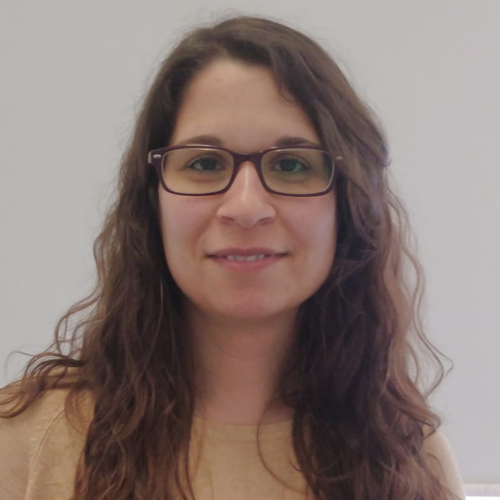
Lénia Isabel Alfaiate Rodrigues
Plant Protection, Genetics & Biotechnology, Integrated in MED
Plant Protection, Genetics & Biotechnology
Integrated in MED



About
Lénia Isabel Alfaiate Rodrigues graduated in Biology from the University of Évora (2009), holds a Master’s degree in Biomedical Sciences from the University of Algarve (2012), and completed her PhD in Biochemistry at the University of Évora (2017). Her professional career includes positions as a research fellow, laboratory manager, and quality assistant in the olive oil sector. In November 2019, she joined the LIVESEED European project at the Molecular Biology Laboratory of the University of Évora, focusing on seed improvement for organic agriculture. During this period, she conducted calorespirometry assays and investigated metabolic responses at the seed proteome level (SDS-PAGE and Western blotting for AOX expression) and transcriptome level (AOX transcript quantification by RT-qPCR).
Between 2021 and 2024, she held a Superior Technician position at MED, followed by a period as Invited Assistant Researcher, and she currently holds a Superior Technician position. Despite her contractual designation, her activity has been predominantly research-oriented, involving project conception, experimental design, coordination of research activities, supervision of students, data analysis, and dissemination of scientific results. She is currently responsible for the Plant Breeding and Biotechnology Laboratory at MED and leads the Plant Proteomics Unit within the Molecular Biology Laboratory.
Her current research focuses on Plant Genetics and Breeding, Plant Biotechnology and Plant Physiology, with particular emphasis on the physiological, biochemical and molecular mechanisms underlying plant responses and adaptation to abiotic stresses, including drought, high temperature and salinity. Her research integrates proteomics, metabolomics and molecular approaches to investigate plant resilience, identify stress-responsive mechanisms and support the development of sustainable strategies for crop improvement and stress mitigation. Her work also includes the evaluation of biostimulants and natural compounds, seed-applied microbial biostimulants, and stress-priming strategies, with applications to relevant crops such as grapevine, olive and forage species.
She has been a member of the research teams of 11 funded research projects, including 9 nationally funded projects, one of which she led as Principal Investigator, and 2 projects funded by the European Union. Her research experience encompasses projects addressing seed improvement for organic agriculture, such as the European project LIVESEED, the application of Opuntia ficus-indica biostimulants to grapevine, the sustainable cultivation of carob (ALCAROB – Applicability of carob tree cultivation for sustainable agriculture in Alentejo), and the recently approved FertiµBioma – Investigação e Desenvolvimento de Novos Microbiomas Funcionais para um Novo Paradigma de Agricultura Sustentável. Currently, as Principal Investigator, she coordinates an IIFA-funded project focused on the application of microbial seed biostimulants to agronomically relevant species, aiming to enhance germination, early plant establishment, and plant tolerance to adverse environmental conditions. Her research activities increasingly integrate plant breeding and biotechnology approaches aimed at enhancing crop resilience and sustainability, in close collaboration with agricultural and research institutions and industry partners.
She was also a volunteer member of the technical-scientific team of the COVID-19 Test Unit at the University of Évora. Over the course of her career, she has actively participated in national and international scientific meetings, presenting 72 posters and 35 oral communications, with abstracts published in official Books of Abstracts. These contributions addressed topics including the molecular regulation of de novo morphogenesis, physiological and molecular mechanisms underlying plant responses to drought, temperature extremes and drought, the use of biostimulants and natural compounds to enhance plant stress tolerance, and the application of metabolomics as a phenotyping tool for discriminating grapevine cultivars.
She has published 23 peer-reviewed scientific articles (two currently under review). Additionally, she is co-author of 4 book chapters, including 1 as first author, and has co-authored 7 scientific outreach articles.
She currently supervises and co-supervises 8 MSc students (out of a total of nine) and 3 PhD students, and throughout her career has guided 18 undergraduate students, eight extracurricular interns and eight summer interns in Biochemistry, Biology, Agronomy and Biotechnology. She recently obtained approval for the patent “METHOD TO DETERMINE TASTE SENSITIVITY BASED ON SALIVARY BIOCHEMICAL MARKERS”.
Since 2023, she has taught practical courses in Cell Biology, Plant Biotechnology, Plant Genetics and Breeding, and Biotechnology, as well as, by invitation, courses addressing biostimulants and their effects on plant physiology. Her teaching and supervision activities are closely connected to her research expertise and contribute to the integration of plant breeding, biotechnology, molecular biology and plant physiology into higher education.
Present Research
- Molecular Markers of Stress Tolerance
- Seed germination
- Plant Breeding
- Microbial seed biostimulants
- Plant responses to abiotic stresses
- Proteomics and Metabolomics
Research Interests
- Seed germination
- Plant Physiology and Biotechnology
- Transcriptomics, Proteomics and Metabolomics
- Biostimulants
- Plant morphogenic processes
- Plant Breeding
Personal Information
| Institutional Email | Send Message |
Thematic lines to which I contribute:
Publications & Patents
| Publication |
|---|
Projects
| Project | Funding | Lead Institution | Role | Start | End | Scope |
|---|---|---|---|---|---|---|
| Estarão as plantas sozinhas? Na descoberta dos microorganismos que as habitam | CIÊNCIA VIVA - Ciência Viva no Laboratório - Criar futuro 2021 | Universidade de Évora | Participant | 2021-08-30 | 2021-09-03 | Nacional |
| MED/BASE - MED: Financiamento base 2020-2023 | FCT - Financiamento Plurianual de Unidades de I&D 2020-2023 | Universidade de Évora | Participant | 2020-01-01 | 2023-12-31 | Nacional |
| O papel dos genes e das proteínas na resposta das plantas aos stresses ambientais | CIÊNCIA VIVA - Ciência Viva no Laboratório - Criar futuro 2021 | Universidade de Évora | MED Representative | 2021-07-26 | 2021-07-30 | Nacional |
| As plantas e os seus hóspedes. O que nos revela o ADN? | CIÊNCIA VIVA - Ciência Viva no Laboratório - Criar Futuro 2022 | Universidade de Évora | Participant | 2022-06-01 | 2022-08-30 | Nacional |
| O papel dos genes e das proteínas na resposta das plantas aos stresses ambientais | CIÊNCIA VIVA - Ciência Viva no Laboratório - Criar Futuro 2022 | Universidade de Évora | MED Representative | 2022-06-01 | 2022-09-30 | Nacional |
| ALCAROB – Aplicabilidade da cultura da alfarrobeira na sustentabilidade da agricultura no Alentejo | Promove - Projetos I&D Mobilizadores 2024 | MED – Instituto Mediterrâneo para a Agricultura, Ambiente e Desenvolvimento | Participant | 2025-01-01 | 2028-01-02 | Nacional |